The Difference Between Hydration and Moisturisation
Hydration refers to the water content within the skin. Moisturisation involves maintaining and preserving that water content while supporting barrier function. Many consumers use these terms interchangeably, but from a formulation perspective they represent distinct biological processes. A complete moisturising strategy typically includes:
- Humectants that attract water
- Emollients that soften and smooth the skin
- Occlusives that reduce water evaporation
- Barrier-supporting ingredients that strengthen the stratum corneum
Facial oils generally function as emollients and, in some cases, occlusives. However, they do not supply water to the skin. This distinction is central to Understanding Water Loss, Humectants, and Skin Barrier Health and explains why oils alone cannot effectively address dehydrated skin.
What Is Transepidermal Water Loss (TEWL)?
The skin continuously loses water through a process known as transepidermal water loss (TEWL).
TEWL occurs when water naturally evaporates from the epidermis into the external environment. While this process is normal, excessive TEWL can contribute to:
- Dehydration
- Rough texture
- Tightness
- Increased sensitivity
- Impaired barrier function
- Accelerated visible signs of ageing
According to the NCBI maintaining a healthy skin barrier is critical for preventing excessive moisture loss and protecting skin integrity. When brands focus on Understanding Water Loss, Humectants, and Skin Barrier Health, they gain a clearer framework for selecting ingredients that support long-term skin performance.
Why Facial Oils Cannot Hydrate Skin
Facial oils create a protective layer on the skin surface. This layer can reduce water evaporation and improve softness, but it does not introduce moisture into the skin. Without available water, oils have little hydration to preserve. A useful analogy is placing a lid on an empty container. The lid prevents contents from escaping, but it does not fill the container. Similarly, facial oils may:
Improve Skin Feel
Oils enhance softness and smoothness by filling microscopic gaps between skin cells.
Reduce Water Loss
Certain oils create a semi-occlusive layer that slows evaporation.
Support Barrier Function
Many plant oils contain fatty acids that help reinforce barrier integrity. However, oils do not:
- Attract significant amounts of water
- Increase skin hydration independently
- Replace humectant functionality
Understanding this distinction helps brands avoid misleading product claims while educating consumers more effectively.
The Critical Role of Humectants
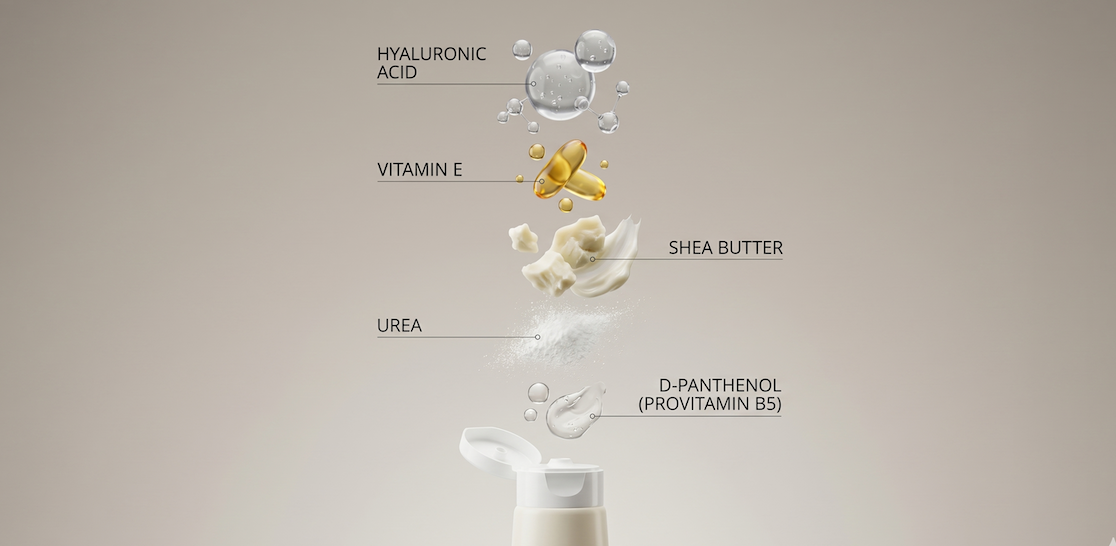
Humectants are among the most important ingredients in hydration-focused formulations. These ingredients attract and bind water from the surrounding environment or deeper skin layers. Common humectants include:
- Glycerin
- Hyaluronic acid
- Sodium PCA
- Panthenol
- Betaine
- Urea
- Propanediol
These ingredients play a direct role because they actively increase water availability within the stratum corneum. For this reason, moisturisers containing effective humectant systems generally outperform oil-only products when addressing dehydration concerns.
The Skin Barrier Connection
The skin barrier serves as the body’s primary defence against environmental stressors while regulating moisture retention. A compromised barrier often leads to:
- Elevated TEWL
- Increased sensitivity
- Reduced resilience
- Visible dryness
- Inflammation
Barrier-supportive ingredients frequently used in modern formulations include:
- Ceramides
- Cholesterol
- Fatty acids
- Niacinamide
- Squalane
- Phytosphingosine
Hydration and barrier repair are not separate formulation goals; they work together to support optimal skin function.
Modern Moisturisers Use Multiple Ingredient Categories
Advanced moisturisers rarely rely on a single ingredient class. Instead, formulators combine humectants, emollients, occlusives and barrier-supportive actives to create comprehensive hydration systems.
A typical moisturiser may include:
| Function | Ingredient Examples |
|---|---|
| Humectants | Glycerin, Hyaluronic Acid, Panthenol |
| Emollients | Squalane, Jojoba Oil, Caprylic/Capric Triglyceride |
| Occlusives | Dimethicone, Petrolatum, Shea Butter |
| Barrier Support | Ceramides, Cholesterol, Niacinamide |
This layered approach reflects the scientific principles Skin Barrier Health and provides superior performance compared to oil-only products.
Consumer Education Creates Market Advantage
As skincare consumers become increasingly ingredient-literate, brands have an opportunity to differentiate themselves through scientific transparency. Explaining the difference between hydration and oil supplementation can help consumers:
- Select products more effectively
- Develop realistic expectations
- Build trust in brand expertise
- Achieve improved skincare outcomes
Brands that invest in educational marketing often strengthen customer loyalty while reducing confusion surrounding product functionality.
The Future of Hydration-Focused Formulation
The next generation of skincare products is increasingly focused on measurable hydration outcomes, barrier repair, and biomimetic ingredient systems. Emerging innovations include:
- Multi-weight hyaluronic acid complexes
- Advanced ceramide delivery systems
- Microbiome-supportive hydrators
- Biomimetic lipid technologies
- Adaptive moisture-retention ingredients
As these technologies evolve, Skin Barrier Health will remain a foundational principle for effective product development.
In Conclusion
Facial oils play an important role in skincare formulations, but they should not be confused with moisturisers. While oils help soften skin and reduce moisture loss, they do not provide the hydration necessary to address dehydration on their own.
For cosmetic brands, formulators, and product developers, Skin Barrier Health provides the scientific framework needed to create effective hydration solutions. By combining humectants, barrier-supporting ingredients, and carefully selected emollients, brands can deliver products that support both immediate skin comfort and long-term skin health.
Partner with HBM for Science-Driven Skincare Development
Whether you are developing a hydration-focused moisturiser, a barrier-repair treatment, or a premium facial oil range, HBM can help bring your product vision to market. Ready to develop your next skincare innovation? Get in touch with HBM to explore tailored formulation and manufacturing solutions for your brand.