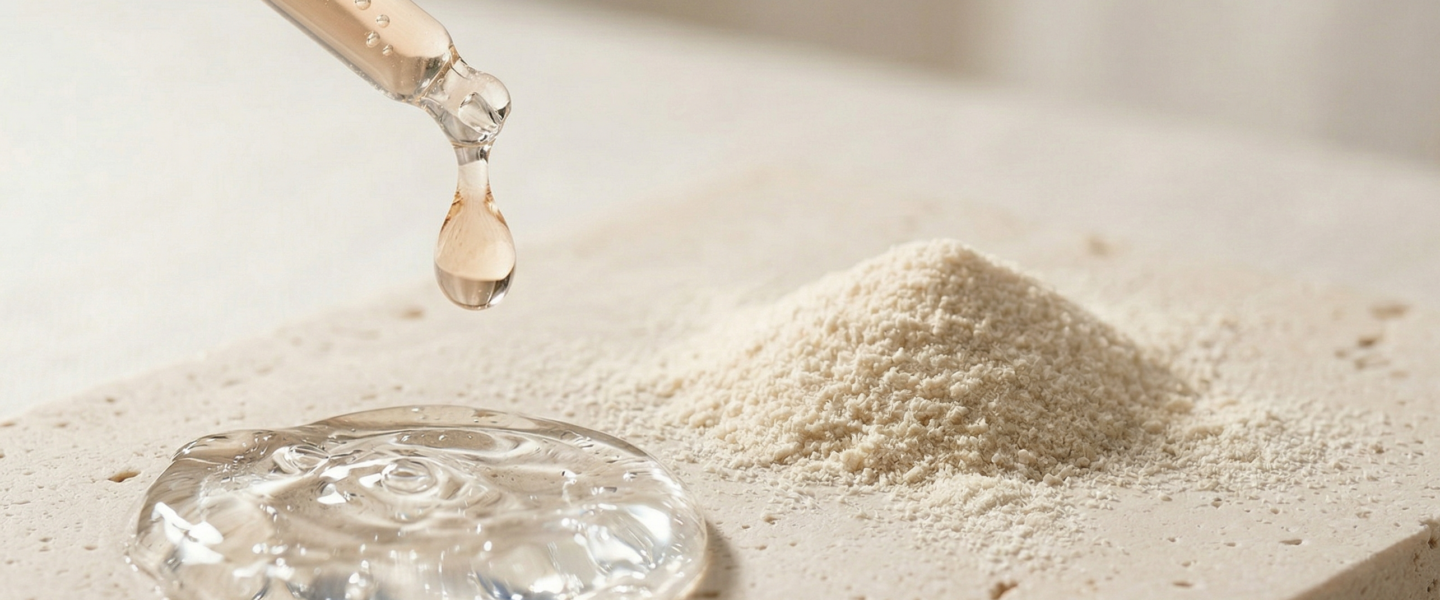
Understanding the Core Difference: Where Each One Works
Every formulation choice comes down to delivery. Topical products act on the surface. They improve hydration, texture, and barrier function. Results are often visible quickly but remain largely superficial. Oral supplements work systemically. Once digested, they influence processes within the dermis and across the body, including collagen synthesis, inflammation, and cellular repair. Skin ageing does not begin at the surface. It develops within the dermis, where collagen, elastin, and hydration networks gradually decline. That is why delivery method matters as much as the ingredient itself.
Collagen: A Case Study in Misunderstood Efficacy
Few ingredients have been marketed as aggressively, or as inaccurately, as collagen.
Topical Collagen
Collagen molecules are large. They do not penetrate the skin barrier in a meaningful way. When applied topically, collagen forms a film on the surface that helps reduce transepidermal water loss. This creates a smoother, more hydrated appearance, but it does not rebuild structural collagen.
Oral Collagen
Once ingested, collagen undergoes enzymatic breakdown into amino acids and bioactive peptides. These peptides circulate in the bloodstream and can stimulate fibroblast activity, the cells responsible for producing collagen in the dermis. Clinical research supports this mechanism. A meta-analysis published via MDPI reviewed 26 randomized controlled trials and found consistent improvements in skin elasticity and hydration with oral collagen supplementation. Additional studies indexed on PubMed show similar outcomes, particularly with sustained use over several weeks.
Types of Collagen Supplements Explained
Not all collagen is formulated equally. The efficacy often depends on its form:
- Hydrolysed Collagen (Collagen Peptides)
This is the most widely used form in supplements. It has been enzymatically broken down into smaller peptides, improving absorption and bioavailability. These peptides are more readily used by the body to support skin, joints, and connective tissue. - Undenatured Collagen (Native Collagen)
Maintains its original triple-helix structure. It is less common in beauty supplements and more often used for joint health. - Gelatin
A partially hydrolysed form of collagen. It offers some nutritional benefits but has lower bioavailability compared to collagen peptides. - Marine vs Bovine Collagen
Marine collagen, typically derived from fish, is rich in Type I collagen and often marketed for skin health. Bovine collagen contains both Type I and Type III, supporting skin as well as connective tissues.
The key takeaway is straightforward: hydrolysed collagen peptides remain the most effective format for skin-related outcomes due to their absorption profile.
The Reality:
Topical collagen improves hydration and surface smoothness. Oral collagen supports structural processes over time.
Verdict: Collagen delivers more meaningful long-term benefits when taken orally, while topical use plays a supportive, cosmetic role.
Hyaluronic Acid: A True Dual-Category Performer
Hyaluronic acid stands apart because it performs well in both formats.
Topical Hyaluronic Acid
Applied to the skin, hyaluronic acid binds water and enhances surface hydration. It creates an immediate plumping effect and improves skin texture within hours.
Oral Hyaluronic Acid
Oral supplementation works differently. After digestion, hyaluronic acid contributes to systemic hydration and supports the extracellular matrix within the skin. Recent clinical findings published through PubMed report improvements in skin hydration, elasticity, and wrinkle depth with consistent oral use. Supporting literature from National Center for Biotechnology Information highlights its role in tissue repair and water retention.
The Reality:
Topical HA delivers immediate results.
Oral HA builds hydration over time.
Verdict: Hyaluronic acid performs best when used both topically and orally.
Antioxidants: Protection From Both Sides
Antioxidants such as vitamin C and polyphenols operate across two fronts.
Topically, they neutralise environmental stressors like UV radiation and pollution. They strengthen the skin barrier and help prevent visible damage.
Orally, they reduce systemic oxidative stress and support collagen synthesis at a cellular level.
Research from institutions such as the National Institutes of Health continues to link oxidative stress with accelerated ageing.
Verdict: Antioxidants are most effective when layered internally and externally.
What Regulation and Research Actually Say
The regulatory divide is clear.
The U.S. Food and Drug Administration classifies topical products as cosmetics, meaning they affect appearance rather than structure. Oral supplements fall under a different category, where they can influence structure and function but are not pre-approved for efficacy in the same way as pharmaceuticals. This distinction explains why topical claims often focus on visible, short-term improvements, while ingestible products aim to support biological processes over time.
The Strategic Insight Most Brands Overlook
Topical skincare delivers immediacy. It refines texture, boosts hydration, and enhances appearance quickly. Oral supplementation works beneath the surface. It supports the systems that determine how skin behaves over time. Consumers who rely on one approach often see partial results. Not because the ingredient fails, but because the delivery strategy is incomplete.
Final Thought
Collagen, hyaluronic acid, and similar crossover ingredients are not interchangeable across formats. They are complementary tools within a broader system. One works at the surface. The other works within. Real results come from aligning both.
If you are investing in your skin, look beyond the ingredient list. Focus on how those ingredients are delivered. The most effective routines combine topical precision with internal support, creating results that are both visible and lasting.
If you are exploring how to develop or position ingestible or topical formulations, or would like to discuss manufacturing and product development opportunities, you can reach out to the team at HBM Cosmetics here.